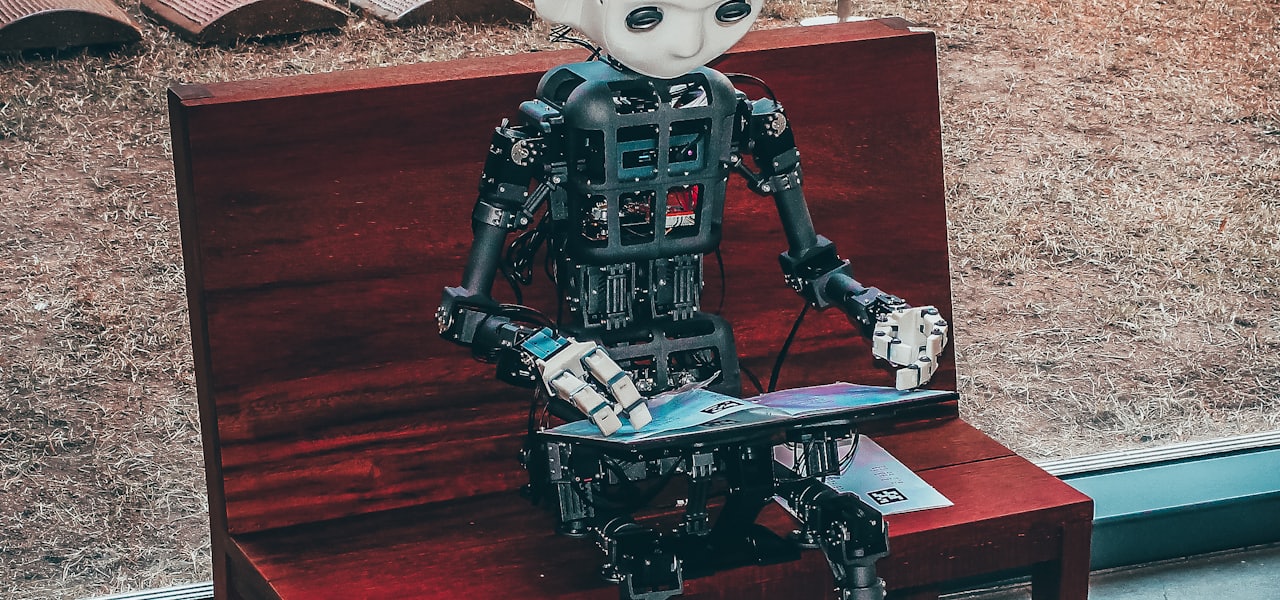
The blocks world is a planning domain in artificial intelligence. It consists of a set of wooden blocks of various shapes and colors sitting on a table. The goal is to build one or more vertical stacks of blocks. Only one block may be moved at a time: it may either be placed on the table or placed atop another block. Because of this, any blocks that are, at a given time, under another block cannot be moved. Moreover, some kinds of blocks cannot have other blocks stacked on top of them. The simplicity of this toy world lends itself readily to classical symbolic artificial intelligence approaches, in which the world is modeled as a set of abstract symbols which may be reasoned about. == Motivation == Artificial Intelligence can be researched in theory and with practical applications. The problem with most practical applications is that the engineers don't know how to program an AI system. Instead of rejecting the challenge at all the idea is to invent an easy to solve domain which is called a toy problem. Toy problems were invented with the aim to program an AI which can solve it. The blocks world domain is an example of a toy problem. Its major advantage over more realistic AI applications is that many algorithms and software programs are available which can handle the situation. This allows comparing different theories against each other. In its basic form, the blocks world problem consists of cubes of the same size which have all the color black. A mechanical robot arm has to pick and place the cubes. More complicated derivatives of the problem consist of cubes of different sizes, shapes and colors. From an algorithmic perspective, blocks world is an NP-hard search and planning problem. The task is to bring the system from an initial state into a goal state. Automated planning and scheduling problems are usually described in the Planning Domain Definition Language (PDDL) notation which is an AI planning language for symbolic manipulation tasks. If something was formulated in the PDDL notation, it is called a domain. Therefore, the task of stacking blocks is a blocks world domain which stands in contrast to other planning problems like the dock worker robot domain and the monkey and banana problem. == Theses/projects which took place in a blocks world == Terry Winograd's SHRDLU Patrick Winston's Learning Structural Descriptions from Examples and Copy Demo Gerald Jay Sussman's Sussman anomaly Decision problem (Gupta and Nau, 1992): Given a starting Blocks World, an ending Blocks World, and an integer L > 0, is there a way to move the blocks to change the starting position to the ending position with L or less steps? This decision problem is NP-hard.
Geo-replication
Geo-replication systems are designed to provide improved availability and disaster tolerance by using geographically distributed data centers. This is intended to improve the response time for applications such as web portals. Geo-replication can be achieved using software, hardware or a combination of the two. == Software == Geo-replication software is a network performance-enhancing technology that is designed to provide improved access to portal or intranet content for users at the most remote parts of large organizations. It is based on the principle of storing complete replicas of portal content on local servers, and then keeping the content on those servers up-to-date using heavily compressed data updates. === Portal acceleration === Geo-replication technologies are used to provide replication of the content of portals, intranets, web applications, content and data between servers, across wide area networks WAN to allow users at remote sites to access central content at LAN speeds. Geo-replication software can improve the performance of data networks that suffer limited bandwidth, latency and periodic disconnection. Terabytes of data can be replicated over a wide area network, giving remote sites faster access to web applications. Geo-replication software uses a combination of data compression and content caching technologies. differencing technologies can also be employed to reduce the volume of data that has to be transmitted to keep portal content accurate across all servers. This update compression can reduce the load that portal traffic places on networks, and improve the response time of a portal. === Portal replication === Remote users of web portals and collaboration environments will frequently experience network bandwidth and latency problems which will slow down their experience of opening and closing files, and otherwise interacting with the portal. Geo-replication technology is deployed to accelerate the remote end user portal performance to be equivalent to that experienced by users locally accessing the portal in the central office. === Differencing engine technologies === To deliver this reduction in the size of the required data updates across a portal, geo-replication systems often use differencing engine technologies. These systems are able to difference the content of each portal server right down to the byte level. This knowledge of the content that is already on each server enables the system to rebuild any changes to the content on one server, across each of the other servers in the deployment from content already hosted on those other servers. This type of differencing system ensures that no content, at the byte level, is ever sent to a server twice. === Offline portal replication on laptops === Geo-replication systems are often extended to deliver local replication beyond the server and down to the laptop used by a single user. Server to laptop replication enables mobile users to have access to a local replica of their business portal on a standard laptop. This technology may be employed to provide in the field access to portal content by, for example, sales forces and combat forces. == Geo-replication systems ==
Imieliński–Lipski algebra
In database theory, Imieliński–Lipski algebra is an extension of relational algebra onto tables with different types of null values. It is used to operate on relations with incomplete information. Imieliński–Lipski algebras are defined to satisfy precise conditions for semantically meaningful extension of the usual relational operators, such as projection, selection, union, and join, from operators on relations to operators on relations with various kinds of "null values". These conditions require that the system be safe in the sense that no incorrect conclusion is derivable by using a specified subset F of the relational operators; and that it be complete in the sense that all valid conclusions expressible by relational expressions using operators in F are in fact derivable in this system. For example, it is well known that the three-valued logic approach to deal with null values, supported treatment of nulls values by SQL is not complete, see Ullman book. To show this, let T be: Take SQL query Q SQL query Q will return empty set (no results) under 3-valued semantics currently adopted by all variants of SQL. This is the case because in SQL, NULL is never equal to any constant – in this case, neither to “Spring” nor “Fall” nor “Winter” (if there is Winter semester in this school). NULL='Spring' will evaluate to MAYBE and so will NULL='Fall'. The disjunction MAYBE OR MAYBE evaluates to MAYBE (not TRUE). Thus Igor will not be part of the answer (and of course neither will Rohit). But Igor should be returned as the answer. Indeed, regardless what semester Igor took the Networks class (no matter what was the unknown value of NULL), the selection condition will be true. This “Igor” will be missed by SQL and the SQL answer would be incomplete according to completeness requirements specified in Tomasz Imieliński, Witold Lipski, 'Incomplete Information in Relational Databases'. It is also argued there that 3-valued logic (TRUE, FALSE, MAYBE) can never provide guarantee of complete answer for tables with incomplete information. Three algebras which satisfy conditions of safety and completeness are defined as Imielinski–Lipski algebras: the Codd-Tables algebra, the V-tables algebra and the Conditional tables (C-tables) algebra. == Codd-tables algebra == Codd-tables algebra is based on the usual Codd's single NULL values. The table T above is an example of Codd-table. Codd-table algebra supports projection and positive selections only. It is also demonstrated in [IL84 that it is not possible to correctly extend more relational operators over Codd-Tables. For example, such basic operation as join is not extendable over Codd-tables. It is not possible to define selections with Boolean conditions involving negation and preserve completeness. For example, queries like the above query Q cannot be supported. In order to be able to extend more relational operators, more expressive form of null value representation is needed in tables which are called V-table. == V-tables algebra == V-tables algebra is based on many different ("marked") null values or variables allowed to appear in a table. V-tables allow to show that a value may be unknown but the same for different tuples. For example, in the table below Gaurav and Igor order the same (but unknown) beer in two unknown bars (which may, or may not be different – but remain unknown). Gaurav and Jane frequent the same unknown bar (Y1). Thus, instead one NULL value, we use indexed variables, or Skolem constants . V-tables algebra is shown to correctly support projection, positive selection (with no negation occurring in the selection condition), union, and renaming of attributes, which allows for processing arbitrary conjunctive queries. A very desirable property enjoyed by the V-table algebra is that all relational operators on tables are performed in exactly the same way as in the case of the usual relations. === Conditional tables (c-tables) algebra === Example of conditional table (c-table) is shown below. It has additional column “con” which is a Boolean condition involving variables, null values – same as in V-tables. over the following table c-table Conditional tables algebra, mainly of theoretical interest, supports projection, selection, union, join, and renaming. Under closed-world assumption, it can also handle the operator of difference, thus it can support all relational operators. == History == Imieliński–Lipski algebras were introduced by Tomasz Imieliński and Witold Lipski Jr. in Incomplete Information in Relational Databases.
Scenery generator
A scenery generator (or terrain generator) is a software used to create landscape images, 3D models, and animations. These programs often use procedural generation to generate the landscapes, or sometimes created and rendered by a 3D artist. These programs are often used in video games or movies. Basic elements of landscapes created by scenery generators include terrain, water, foliage, and clouds. The process for basic random generation uses a diamond square algorithm. == Common features == Most scenery generators can create basic heightmaps to simulate the variation of elevation in basic terrain. Common techniques include Simplex noise, fractals, or the diamond-square algorithm, which can generate 2-dimensional heightmaps. A version of scenery generator can be very simplistic. Using a diamond-square algorithm with some extra steps involving fractals, an algorithm for random generation of terrain can be made with only 120 lines of code. The program in example takes a grid and then divides the grid repeatedly. Each smaller grid is then split into squares and diamonds and the algorithm then makes the randomized terrain for each square and diamond. Most programs for creating landscapes also allow for adjustment and editing of the landscape. For example, World Creator allows for terrain sculpting, which uses a similar brush system as Photoshop, and allows for additional terrain enhancement with its procedural techniques such as erosion, sediments, and more. Other tools in the World Creator program include terrain stamping, which allows you to import elevation maps and use them as a base. The programs tend to also allow for additional placement of rocks, trees, etc. These can be done procedurally or by hand depending on the program. Typically the models used for the placement objects are the same as to lessen the amount of work that would be done if the user was to create a multitude of different trees. The terrain generated the computer does a generation of multifractals then integrates them until finally rendering them onto the screen. These techniques are typically done “on-the-fly” which typically for a 128 × 128 resolution terrain would mean 1.5 seconds on a CPU from the early 1990s. == Applications == Scenery generators are commonly used in movies, animations, 3D rendering, and video games. For example, Industrial Light & Magic used E-on Vue to create the fictional environments for Pirates of the Caribbean: Dead Man's Chest. In such live-action cases, a 3D model of the generated environment is rendered and blended with live-action footage. Scenery generated by the software may also be used to create completely computer-generated scenes. In the case of animated movies such as Kung Fu Panda, the raw generation is assisted by hand-painting to accentuate subtle details. Environmental elements not commonly associated with landscapes, such as ocean waves, have also been handled by the software. Scenery generation is used in most 3D based video-games. These typically use either custom or purchased engines that contain their own scenery generators. For some games they tend to use a procedurally generated terrain. These typically use a form of height mapping and use of Perlin noise. This will create a grid that with one point in a 2D coordinate will create the same heightmap as it is pseudorandom, meaning it will result in the same output with the same input. This can then easily be translated into the product 3D image. These can then be changed from the editor tools in most engines if the terrain will be custom built. With recent developments neural networks can be built to create or texture the terrain based on previously suggested artwork or heightmap data. These would be generated using algorithms that have been able to identify images and similarities between them. With the info the machine can take other heightmaps and render a very similar looking image to the style image. This can be used to create similar images in example a Studio Ghibli or Van Gogh art-style. == Software == Most game engines, whether custom or proprietary, will have terrain generation built in. Some terrain generator programs include, Terragen, which can create terrain, water, atmosphere and lighting; L3DT, which provides similar functions to Terragen, and has a 2048 × 2048 resolution limit; and World Creator, which can create terrain, and is fully GPU powered. === List of 3D terrain generation software ===
Zero-day vulnerability
A zero-day (also known as a 0-day) is a vulnerability or security hole in a computer system unknown to its developers or anyone capable of mitigating it. Until the vulnerability is remedied, threat actors can exploit it in a zero-day exploit, or zero-day attack. The term "zero-day" originally referred to the number of days since a new piece of software was released to the public, so "zero-day software" was obtained by hacking into a developer's computer before release. Eventually the term was applied to the vulnerabilities that allowed this hacking, and to the number of days that the vendor has had to fix them. Vendors who discover the vulnerability may create patches or advise workarounds to mitigate it, though users need to deploy that mitigation to eliminate the vulnerability in their systems. Zero-day attacks are severe threats. == Definition == Despite developers' goal of delivering a product that works entirely as intended, virtually all products contain software and hardware bugs. If a bug creates a security risk, it is called a vulnerability. Vulnerabilities vary in their ability to be exploited by malicious actors. Some are not usable at all, while others can be used to disrupt the device with a denial of service attack. The most dangerous allow the attacker to inject and run their own code, without the user being aware of it. Although the term "zero-day" initially referred to the time since the vendor had become aware of the vulnerability, zero-day vulnerabilities can also be defined as the subset of vulnerabilities for which no patch or other fix is available. A zero-day exploit is any exploit that takes advantage of such a vulnerability. == Exploits == An exploit is the delivery mechanism that takes advantage of the vulnerability to penetrate the target's systems, for such purposes as disrupting operations, installing malware, or exfiltrating data. Researchers Lillian Ablon and Andy Bogart write that "little is known about the true extent, use, benefit, and harm of zero-day exploits". Exploits based on zero-day vulnerabilities are considered more dangerous than those that take advantage of a known vulnerability. However, it is likely that most cyberattacks use known vulnerabilities, not zero-days. Governments of states are the primary users of zero-day exploits, not only because of the high cost of finding or buying vulnerabilities, but also the significant cost of writing the attack software. Nevertheless, anyone can use a vulnerability, and according to research by the RAND Corporation, "any serious attacker can always get an affordable zero-day for almost any target". Many targeted attacks and most advanced persistent threats rely on zero-day vulnerabilities. In 2017, the average time to develop an exploit from a zero-day vulnerability was estimated at 22 days. The difficulty of developing exploits has been increasing over time due to increased anti-exploitation features in popular software. === Window of vulnerability === Zero-day vulnerabilities are often classified as alive—meaning that there is no public knowledge of the vulnerability—and dead—the vulnerability has been disclosed, but not patched. If the software's maintainers are actively searching for vulnerabilities, it is a living vulnerability; such vulnerabilities in unmaintained software are called immortal. Zombie vulnerabilities can be exploited in older versions of the software but have been patched in newer versions. Even publicly known and zombie vulnerabilities are often exploitable for an extended period. Security patches can take months to develop, or may never be developed. A patch can have negative effects on the functionality of software and users may need to test the patch to confirm functionality and compatibility. Larger organizations may fail to identify and patch all dependencies, while smaller enterprises and personal users may not install patches. Research suggests that risk of cyberattack increases if the vulnerability is made publicly known or a patch is released. Cybercriminals can reverse engineer the patch to find the underlying vulnerability and develop exploits, often faster than users install the patch. According to research by RAND Corporation published in 2017, zero-day exploits remain usable for 6.9 years on average, although those purchased from a third party only remain usable for 1.4 years on average. The researchers were unable to determine if any particular platform or software (such as open-source software) had any relationship to the life expectancy of a zero-day vulnerability. Although the RAND researchers found that 5.7 percent of a stockpile of secret zero-day vulnerabilities will have been discovered by someone else within a year, another study found a higher overlap rate, as high as 10.8 percent to 21.9 percent per year. == Countermeasures == Because, by definition, there is no patch that can block a zero-day exploit, all systems employing the software or hardware with the vulnerability are at risk. This includes secure systems such as banks and governments that have all patches up to date. Security systems are designed around known vulnerabilities, and repeated exploitations of a zero-day exploit could continue undetected for an extended period of time. Although there have been many proposals for a system that is effective at detecting zero-day exploits, this remains an active area of research in 2023. Many organizations have adopted defense-in-depth tactics so that attacks are likely to require breaching multiple levels of security, which makes it more difficult to achieve. Conventional cybersecurity measures such as training and access control — including multi-factor authentication, least-privilege access, and air-gapping makes it harder to compromise systems with a zero-day exploit. Since writing perfectly secure software is impossible, some researchers argue that driving up the cost of exploits is considered a good strategy to reduce the burden of cyberattacks. == Market == Zero-day exploits can fetch millions of dollars. There are three main types of buyers: White: the vendor, or to third parties such as the Zero Day Initiative that disclose to the vendor. Often such disclosure is in exchange for a bug bounty. Not all companies respond positively to disclosures, as they can cause legal liability and operational overhead. It is not uncommon to receive cease-and-desist letters from software vendors after disclosing a vulnerability for free. Gray: the largest and most lucrative. Government or intelligence agencies buy zero-days and may use it in an attack, stockpile the vulnerability, or notify the vendor. The United States federal government is one of the largest buyers. As of 2013, the Five Eyes (United States, United Kingdom, Canada, Australia, and New Zealand) captured the plurality of the market and other significant purchasers included Russia, India, Brazil, Malaysia, Singapore, North Korea, and Iran. Middle Eastern countries were poised to become the biggest spenders. Black: organized crime, which typically prefers exploit software rather than just knowledge of a vulnerability. These users are more likely to employ "half-days" where a patch is already available. In 2015, the markets for government and crime were estimated at least ten times larger than the white market. Sellers are often hacker groups that seek out vulnerabilities in widely used software for financial reward. Some will only sell to certain buyers, while others will sell to anyone. White market sellers are more likely to be motivated by non pecuniary rewards such as recognition and intellectual challenge. Selling zero-day exploits is legal. Despite calls for more regulation, law professor Mailyn Fidler says there is little chance of an international agreement because key players such as Russia and Israel are not interested. The sellers and buyers that trade in zero-days tend to be secretive, relying on non-disclosure agreements and classified information laws to keep the exploits secret. If the vulnerability becomes known, it can be patched and its value consequently crashes. Because the market lacks transparency, it can be hard for parties to find a fair price. Sellers might not be paid if the vulnerability was disclosed before it was verified, or if the buyer declined to purchase it but used it anyway. With the proliferation of middlemen, sellers could never know to what use the exploits could be put. Buyers could not guarantee that the exploit was not sold to another party. Both buyers and sellers advertise on the dark web. Research published in 2022 based on maximum prices paid as quoted by a single exploit broker found a 44 percent annualized inflation rate in exploit pricing. Remote zero-click exploits could fetch the highest price, while those that require local access to the device are much cheaper. Vulnerabilities in widely used software are also more expensive. They estimated that around 400 to 1,500 people sold exploits to th
Cybernetic Serendipity
Cybernetic Serendipity was an exhibition of cybernetic art curated by Jasia Reichardt, shown at the Institute of Contemporary Arts, London, England, from 2 August to 20 October 1968, and then toured across the United States. Two stops in the United States were the Corcoran Annex (Corcoran Gallery of Art), Washington, D.C., from 16 July to 31 August 1969, and the newly opened Exploratorium in San Francisco, from 1 November to 18 December 1969. == Content == One part of the exhibition was concerned with algorithms and devices for generating music. Some exhibits were pamphlets describing the algorithms, whilst others showed musical notation produced by computers. Devices made musical effects and played tapes of sounds made by computers. Peter Zinovieff lent part of his studio equipment - visitors could sing or whistle a tune into a microphone and his equipment would improvise a piece of music based on the tune. Another part described computer projects such as Gustav Metzger's self-destructive Five Screens With Computer, a design for a new hospital, a computer programmed structure, and dance choreography. The machines and installations were a very noticeable part of the exhibition. Gordon Pask produced a collection of large mobiles (Colloquy of Mobiles (1968)) with interacting parts that let the viewers join in the conversation. Many machines formed kinetic environments or displayed moving images. Bruce Lacey contributed his radio-controlled robots and a light-sensitive owl. Nam June Paik was represented by Robot K-456 and televisions with distorted images. Jean Tinguely provided two of his painting machines. Edward Ihnatowicz's biomorphic hydraulic ear (Sound Activated Mobile (SAM, 1968)) turned toward sounds and John Billingsley's Albert 1967 turned to face light. Wen-Ying Tsai presented his interactive cybernetic sculptures of vibrating stainless-steel rods, stroboscopic light, and audio feedback control. Several artists exhibited machines that drew patterns that the visitor could take away, or involved visitors in games. Cartoonist Rowland Emett designed the mechanical computer Forget-me-not, which was commissioned by Honeywell. Another section explored the computer's ability to produce text - both essays and poetry. Different programs produced Haiku, children's stories, and essays. One of the first computer-generated poems, by Alison Knowles and James Tenney, was included in the exhibition and catalogue. Computer-generated movies were represented by John Whitney's Permutations and a Bell Labs movie on their technology for producing movies. Some samples included images of tesseracts rotating in four dimensions, a satellite orbiting the Earth, and an animated data structure. Computer graphics were also represented, including pictures produced on cathode ray oscilloscopes and digital plotters. There was a variety of posters and graphics demonstrating the power of computers to do complex (and apparently random) calculations. Other graphics showed a simulated Mondrian and the iconic decreasing squares spiral that appeared on the exhibition's poster and book. The Boeing Company exhibited their use of wireframe graphics. The innovative computer-generated sculpture, Quad 1, was displayed at the Cybernetic Serendipity exhibit. Created by the American abstract expressionist sculptor, Robert Mallary, in 1968, Quad 1 is widely believed to be the world's first Computer Aided Design sculpture. Keith Albarn & Partners contributed to the design of the exhibition. Reflecting the prominence of music in the show, a ten-track album Cybernetic Serendipity Music was released by the ICA to accompany the show. Artists featured included Iannis Xenakis, John Cage, and Peter Zinovieff, a detail of whose graphic score for 'Four Sacred April Rounds’ (1968) was used as the cover artwork. == Attendance == Time magazine noted that there had been 40,000 visitors to the London exhibition. Other reports suggested visitor numbers were as high as 44,000 to 60,000. However, the ICA did not accurately count visitors. == After-effects == The exhibition provided the energy for the formation of British Computer Arts Society which continued to explore the interaction between science, technology and art, and put on exhibitions (for example Event One at the Royal College of Art). Several pieces were purchased by the Exploratorium in 1971, some of which are on display to this day. In 2014 the ICA held a retrospective exhibition Cybernetic Serendipity: A Documentation which included documents, installation photographs, press reviews and publications and a series of discussions in one of which Peter Zinovieff took part. To coincide with the exhibition, Cybernetic Serendipity Music was re-released as a limited-edition vinyl LP by The Vinyl Factory. The Victoria and Albert Museum marked the 50th anniversary with an exhibition in 2018 entitled "Chance and Control: Art in the Age of Computers". The V&A exhibition included many works by artists who featured in the original ICA show, plus related ephemera. "Chance and Control" subsequently toured to Chester Visual Arts and Firstsite, Colchester. In 2020, The Centre Pompidou exhibited the replica of Gordon Pask's 1968 Colloquy of Mobiles, reproduced by Paul Pangaro and TJ McLeish in 2018. In 2022 the Australian National University's School of Cybernetics launched the school by presenting an exhibition Australian Cybernetic: a point through time. The exhibition included works from Cybernetic Serendipity (1968), Australia ‘75: Festival of Creative Arts and Science (1975), and contemporary pieces curated by the School of Cybernetics. In describing Reichardt's Cybernetic Serendipity exhibition the school stated that it "represented points of expanding the cybernetic imagination" and was a "ground-breaking" "glimpse of a future in which computers were entangled with people and cultures, and through this she fashioned a blueprint for the future of computing that has since inspired generations".
Czekanowski distance
The Czekanowski distance (sometimes shortened as CZD) is a per-pixel quality metric that estimates quality or similarity by measuring differences between pixels. Because it compares vectors with strictly non-negative elements, it is often used to compare colored images, as color values cannot be negative. This different approach has a better correlation with subjective quality assessment than PSNR. == Definition == Androutsos et al. give the Czekanowski coefficient as follows: d z ( i , j ) = 1 − 2 ∑ k = 1 p min ( x i k , x j k ) ∑ k = 1 p ( x i k + x j k ) {\displaystyle d_{z}(i,j)=1-{\frac {2\sum _{k=1}^{p}{\text{min}}(x_{ik},\ x_{jk})}{\sum _{k=1}^{p}(x_{ik}+x_{jk})}}} Where a pixel x i {\displaystyle x_{i}} is being compared to a pixel x j {\displaystyle x_{j}} on the k-th band of color – usually one for each of red, green and blue. For a pixel matrix of size M × N {\displaystyle M\times N} , the Czekanowski coefficient can be used in an arithmetic mean spanning all pixels to calculate the Czekanowski distance as follows: 1 M N ∑ i = 0 M − 1 ∑ j = 0 N − 1 ( 1 − 2 ∑ k = 1 3 min ( A k ( i , j ) , B k ( i , j ) ) ∑ k = 1 3 ( A k ( i , j ) + B k ( i , j ) ) ) {\displaystyle {\frac {1}{MN}}\sum _{i=0}^{M-1}\sum _{j=0}^{N-1}{\begin{pmatrix}1-{\frac {2\sum _{k=1}^{3}{\text{min}}(A_{k}(i,j),\ B_{k}(i,j))}{\sum _{k=1}^{3}(A_{k}(i,j)+B_{k}(i,j))}}\end{pmatrix}}} Where A k ( i , j ) {\displaystyle A_{k}(i,j)} is the (i, j)-th pixel of the k-th band of a color image and, similarly, B k ( i , j ) {\displaystyle B_{k}(i,j)} is the pixel that it is being compared to. == Uses == In the context of image forensics – for example, detecting if an image has been manipulated –, Rocha et al. report the Czekanowski distance is a popular choice for Color Filter Array (CFA) identification.